Listeners:
Top listeners:
-
 play_arrow
97.5 GOLDEN FM Nr.1 For New Music And All The Hits!
-
play_arrow
Demo Radio Techno Top Music Radio
STAKEHOLDERS IN BAYELSA FAULT IOC’S OVER LACK OF TRANSPARENCY IN ASSET DIVESTMENT
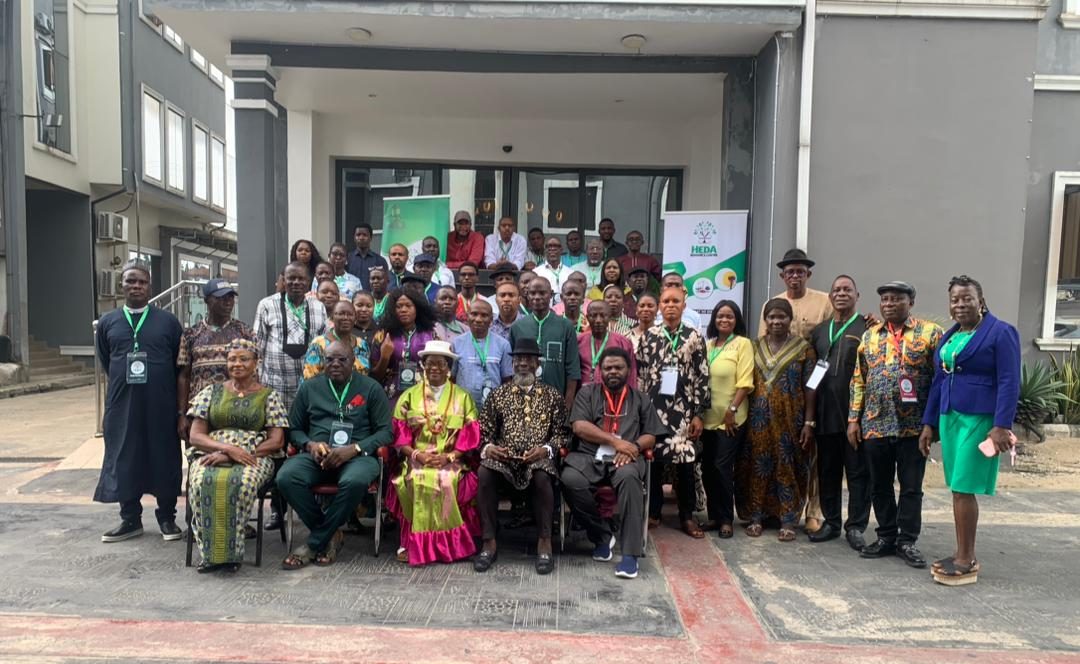
Stakeholders from oil-producing communities in Bayelsa State have criticised multinational oil companies for allegedly excluding host communities from the oil asset divestment process.
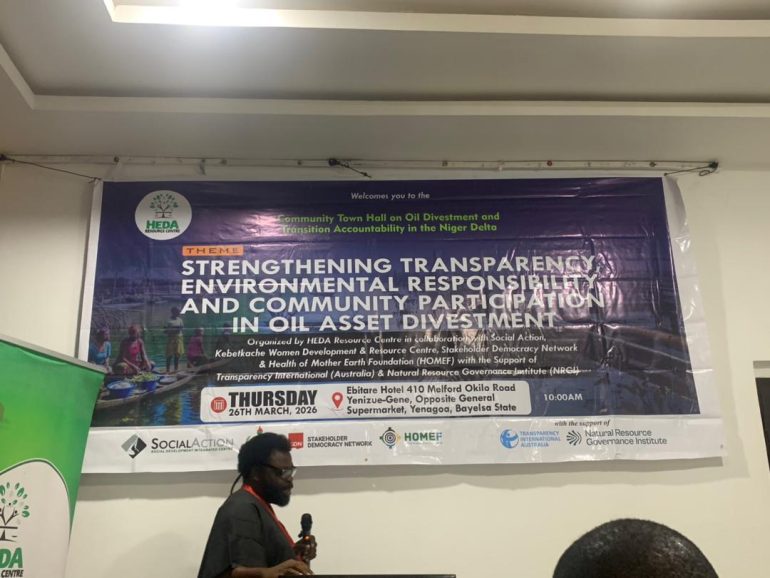
The stakeholders made this known on Thursday, March 28, 2026 during a one-day town hall meeting organised by the Human and Environmental Development Agenda (HEDA) with the theme, “Strengthening Transparency, Environmental Responsibility and Community Participation in Oil Asset Divestment,” with support from Transparency International Australia and the Natural Resource Governance Institute.
They stressed the need for a cleaner and healthier environment for residents of oil-producing communities.
The Executive Secretary of HEDA, Mr Arigbabu Sulaimon, said the meeting was aimed at promoting accountability and transparency in the divestment process in the Niger Delta.
He said, “The purpose of coming to Bayelsa is to assess the divestment that has taken place and determine the level of compliance by regulators and multinational oil companies with the seven-point framework and the Petroleum Industry Act.”
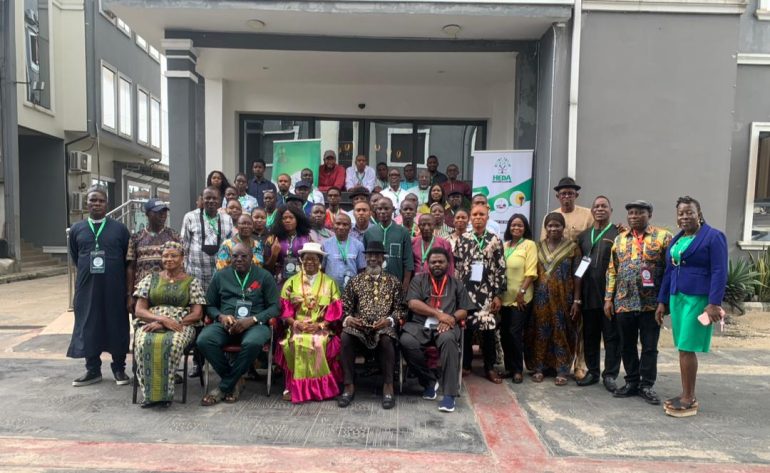
Sulaimon, however, lamented that the divestment process in Bayelsa was not inclusive. “From what we have gathered, the process is not inclusive. Communities have not been adequately engaged. We are here to hear from the people and determine the extent to which reparations and remediation can still be achieved,” he added.
He also called for reforms to the Petroleum Industry Act, noting that it had not fully addressed the concerns of host communities.
A facilitator at the meeting, Mr Godson Jim-Dorgu, said there was a need to sensitise communities on oil exploration processes and develop strategies for engaging oil companies and government.
“It is important to create awareness and develop a roadmap for communities to engage the IOCs, the government, and even the international community where necessary,” he said.
He decried the decline in engagement between oil companies and host communities, alleging that many operators were no longer accessible for dialogue.
Also speaking, the Regent of Lasukugbene community in Southern Ijaw Local Government Area, Chief Zion Kientei, said communities were not adequately carried along in the divestment process.
He noted that although two indigenous oil companies were granted licences in 2022, with one already producing, the community had limited involvement beyond ensuring peaceful operations.
“We try to ensure their activities are environmentally friendly, but there are still unresolved legal issues due to unfulfilled promises,” he said.
Kientei added that the community had adopted measures to monitor air quality and hold operators accountable for environmental changes.
An official from the Director at the Ministry of Environmental in Bayelsa, Engr Enai Reuben, said inadequate government involvement in the divestment process was contributing to the challenges.
“The state government needs to be fully involved in discussions and decision-making. There should also be proper facility assessments before divestment to determine the environmental status,” he said.
He also cited a lack of technical expertise as a major challenge.
On his part, the Director of Biodiversity, Climate Change and Watersheds at Niger Delta University, Prof Joe Alagoa, attributed many of the issues to ignorance and complicity.
He called for increased awareness and the engagement of qualified professionals in environmental management, while also raising concerns over unregulated dredging activities.
According to a communiqué issued at the end of the meeting, participants expressed concern over the lingering impact of oil pollution in the region.
“The 2011 Bonga oil spill, in which Shell admitted releasing over 40 million barrels of crude oil into the Atlantic Ocean, continues to devastate fisheries and livelihoods across the Niger Delta, with no adequate accountability or remediation,” the communiqué read.
It added that some communities were still experiencing frequent oil spills and severe health challenges linked to environmental pollution.
The stakeholders called for urgent public awareness on environmental rights, particularly the 21-day window provided under the Environmental Impact Assessment Act for communities to challenge projects.
They also urged collaboration among civil society groups, environmental experts, and government agencies to assess environmental damage and ensure accountability in the divestment process.
Reported by Bright Okpo


On Air
Top popular

Stainless Steel Juicer – Making Juicing Fun And Easy

Me – Too Was Needed, But Has It Gone Too – Far?: 4 Considerations!

Can the Crestron Home Automation System Be Integrated With Sonos?

POLICE RAID AMARATA COMMUNITY AFTER KILLING OF OFFICER

We Need To Elect Public Leaders, Willing To DIRECT Us, Properly!


